


The brief was straightforward: help an AI hardware startup find its voice and a distinctive look in an industry already drowning in a sea of sameness.
Normal Computing builds hardware to solve AI’s computing crisis: the ballooning cost and energy demands of running large-scale AI systems. Their founders came from Google Brain and Google X. Their technology was genuinely novel. And yet when they came to us, they had no clear story and an identity that looked like everything else in the space.
So naturally, we stopped looking at the AI industry entirely.
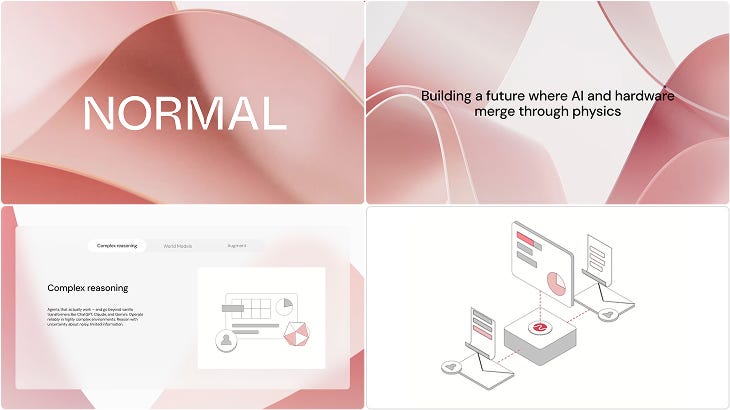
Normal Is Not a Dirty Word
Before aesthetics, we had to get to language. And there was a tension sitting right inside the company’s name.
In art, music, culture: abnormal is great. Being weird is the point. But open your phone and find it behaving abnormally? That’s a crisis. In technology, “normal” doesn’t mean ordinary. It means working correctly. When things are normal in a semiconductor plant or an AI pipeline, that’s not a failure of ambition. That’s the entire goal.
Once we landed on that reframe, the brand story followed: Predictable is Powerful. The tagline: Today’s innovations are tomorrow’s Normal. A mission statement and a provocation that turned the company’s name from a liability into a philosophy.
The Invisible Physics of Normal
With the verbal identity set, we started asking a different kind of question: what does “normal” actually look like in the physical world?
When you walk outside, there’s wind, air, sunlight. Forces you can’t see, but when they’re working, you don’t think about them. They just are. That’s exactly what Normal Computing’s technology does for AI infrastructure: it makes the invisible, the expensive, the unstable work the way it’s supposed to. Quietly. Reliably. Naturally.
That became the visual brief. Not AI. Not tech. The physics of the world around us.
Don’t Look at Your Category
Our rule when we impose on ourselves before we start building a brand is: don’t look at the category. Don’t look at finance if you’re in finance. Don’t look at AI if you’re in AI. Look at nature. Look at art. Look at things that exist outside the space entirely, because that’s the only way to make something that doesn’t look like everything else in it.
For Normal, that meant deliberately setting aside the default AI visual language: the gradients, the glowing meshes, the flashy motion. Instead, we grounded the identity in classicism: research, invisible forces, humanist typography with history in its bones, rooted in the hand rather than the machine.
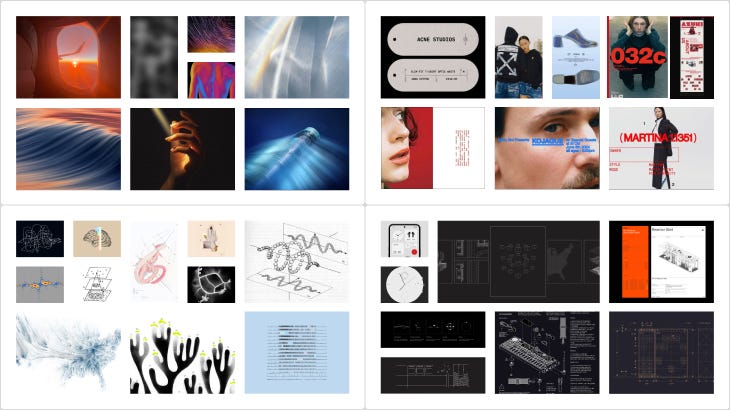
And we looked at fashion. Not as decoration, but as design philosophy. A good garment doesn’t announce its construction. It announces the person inside it. We kept asking: why couldn’t this brand feel like something you could put on?
Paired with a strict red, white, and black palette and a visual system built around geometric precision and natural physical forms, the result felt unlike anything else in the space. Precise without being cold. Confident without being loud. And an identity that clearly told Normal’s unique story and approach to building the future of AI.
What Happened
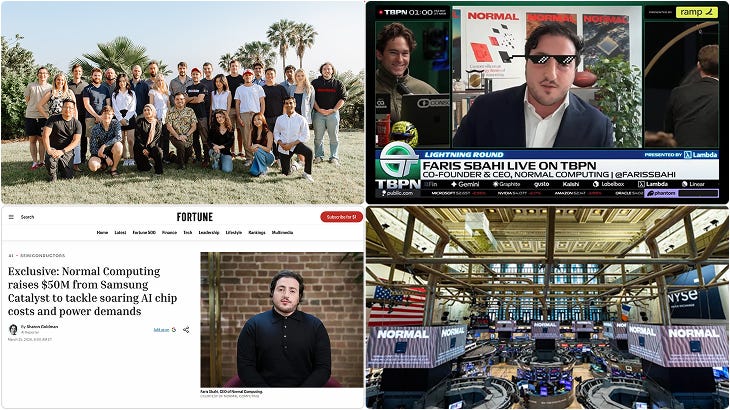
Normal Computing raised $50 million from Samsung Catalyst. Their CEO appeared in Fortune. The brand ran on the floor of the New York Stock Exchange.
We still work with them, expanding the brand system, and helping them continue to tell their story as they grow and mature.
The AI industry has a sameness problem. It’s not a technology problem; it’s a communication one. Too many companies are so focused on their own category that they’ve forgotten to look at the world around it.
Differentiation requires departure. An obvious example: Apple we hear clients reference again and again, but why? They rooted themselves in simplicity and humanity, a departure from the cold corporate image of 1970s tech companies. They didn’t compete in their category; they made the category, as it was, feel obsolete.
The most interesting decisions we made for Normal didn’t come from studying AI. They came from the world around us: from the physics of things that work without being noticed, to the extension of self that wants to be noticed.
Inspiring. Such a beautiful read as I’m working on a Brand project for Middle Eastern AI brand.