


Launching a successful brand takes more than great creativity. It takes a strategy that holds up, a launch that clearly reaches its audience where they are, and a creative counterpart team that feels like your team (not a vendor you check in with).
We’re a small studio, and it’s by design: so that we can embed with other teams, react quickly, and lead with strategy to guide our design decisions.
But we’d rather you hear it from a client than from us. So, we asked Pavilion CMO Matt Spangler to discuss how we built the Pavilion brand together, with Company Policy Founder & CCO Adam Katz filling in the other side. Pavilion brings local vacation rental companies together as one national company, with each one still locally led, and it launched in October. Here’s how we did it, from kickoff to go-live.
Establishing the foundation
WC: What were the key brand needs for Pavilion’s launch, and who is the audience?
MS: Every vacation home is owned by someone, and plenty of owners don’t want to run it like a hotel, so local companies around the country provide that hospitality layer. Pavilion brings the best of them together and gives them scale, with the local founders as equity partners. That meant the brand needed three things: an extensible design system, a human feel, and a clear national footprint.
WC: The launch needs were strategic as well as visual. Who and what were you solving for?
AK: We focused first on the core local companies, but the bigger question was always how to go bigger, and that shaped the brand system.
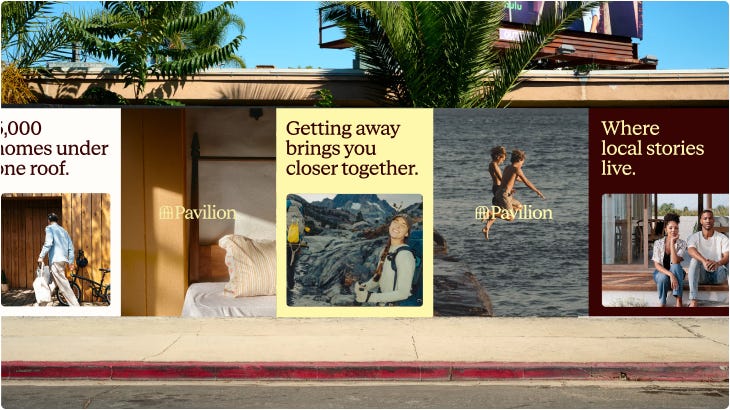
MS: You have to be grounded in what you need today while holding big ambitions for where the brand can go. Today, that means more property management companies joining us, so we launched at the industry’s biggest conference, in Nashville, with T-shirts at a free coffee event outside, ads in the airport as people flew in, and animation highlighting our markets. Over time, we want guests to view Pavilion as the first place to go for a trusted home, and so we designed the system for both.
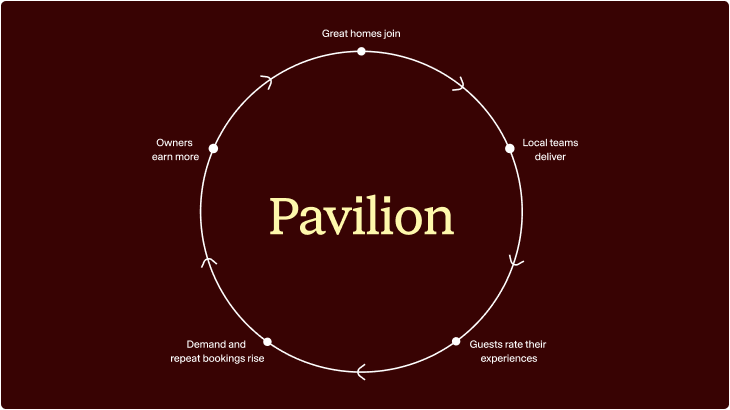
WC: Pavilion’s point of view was clear: win homeowners and keep local identities intact. How did the strategy turn that into a brand people could rally around?
MS: We championed the entrepreneurs and their local stories, and we made the brand extensible so everyone could feel a part of a bigger community. Then we gave them tools they can actually use: owner statements and leave-behind materials for local realtor meetings. So the strategy became a way to enable and empower the local companies, and they get excited because it gives them something to aspire to and helps them get there.
Refining the Strategy
WC: Pavilion shared its competitive landscape up front. How did Company Policy build on it, and what stood out once the studio layered in its own analysis?
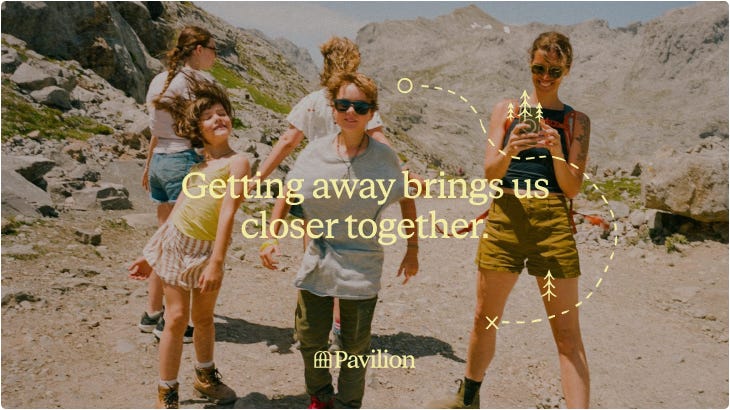
AK: Having the landscape mapped out up front was a big head start, because we’re not experts in the vacation rental industry. What stood out is how much of the category leans on the same look: perfect beaches, posed smiles, lots of gold and beige, and a “high-end” feel that rarely seems approachable or realistic. Authenticity was the word that was missing, along with the feel of the real people who make the vacation experience shine. And since the brand had to represent so many places and people, we zeroed in on illustration, which felt distinct in the category. It came partly from classic postcards, the “Greetings from Asbury Park“ kind. We didn’t copy the style, but we borrowed the feeling that this could be for anybody, a memory of your favorite vacation.
WC: At what point in the strategy phase did Company Policy know it had the right direction?
AK: Pretty early, once we figured out the local side of things, it seeped into the whole strategy: travel like a local, be a local where you are, and local pride for the people who live and work there. Matt, you involved us early in the naming conversations and let us be a fly on the wall with some of the local companies, and the pride and sense of ownership they have for their places made it almost a no-brainer to lean into.
WC: How do you keep a national brand from flattening the local ones?
AK: Matt’s league metaphor, where Pavilion is the NBA and the local companies are the individual teams that share a relationship, helped us understand better how the brand system needed to work. The real question was how rigid and systematized the “teams” or local management companies needed to get within the brand, so we deliberately backed away from strict rules and asked how much of their own identity each company should keep.
Building a Partnership
WC: Having worked with Company Policy before, what made the studio the right partner for Pavilion?
MS: Adam and I have known each other a long time, and I wanted a well-rounded team: strong graphic design, copywriting and storytelling, and motion experience to bring things to life. They also deliver output that’s practical, things that actually get seen and used, and you see that in the video, ads, and social for Pavilion. And they’re easygoing and solve problems. If we have to shift direction, it’s “not a big deal, let’s talk about it and do it.”
AK: As we got closer to launch, Matt’s team, and Erik (Director of Brand and Content at Pavilion) in particular, stress tested the brand as we created various marketing collateral. Their focus being: make sure the brand is usable immediately today and adjustable for the future. Having that kind of partner on the client side made a real difference.
WC: How did the Company Policy and Pavilion teams work together day to day, and when did it start to feel like one team?
MS: From day one. Having worked together before, there’s a comfort level that makes them part of the team immediately, and I told them I saw this as a long partnership, not a single project. A weekly cadence helped, Nicole (Company Policy Head of Ops) is a great producer who keeps everything in line, and having Erik there from the beginning made it feel like one creative team.
WC: The photography and illustration feel more like a real vacation than a brochure. How did that direction come about?
MS: We worked to choose the art direction of illustration and photography to feel like an old, filmic vacation photo or moment. The images we’ve chosen, and how we show people in them, aren’t staged stock-photo moments. It feels like real life.
AK: One of the big unlocks, and we hit on it early, was nostalgia, or really just memory. Matt, you brought it up early on: what was the best vacation you ever took? We tried to elicit that memory through the brand, and the photography direction hits on it. You want people to feel that this is a special place with real care behind it, from the owners to the people looking after the house, and that kind of authenticity is hard to find in stock.
WC: Pavilion speaks to homeowners, guests, and local founders, across everything from ski houses to beach condos. How did the brand come to feel like one?
AK: For the big brand moments, we wanted something that could represent any of those audiences and any location, so it didn’t feel like we were speaking to only one sector of the audience or one place. That’s really why we moved into illustration. We also made sure each of the three audiences was discussed and brought into the brand, in the photography and the communication too, instead of making the local founders feel secondary. They were involved in the language pretty early on as well.
Launch and Beyond
WC: Launching Pavilion meant many workstreams running at once, with local companies to bring along. How did you keep it on track, and what did the studio take off your plate?
MS: They act like part of the team. On the launch deliverables I’d say, “We need an ad and a brand video for this launch, you have two weeks,” and they just jumped in and kept revising right up to the end. They were never the kind of team that says there isn’t enough time to do something great. Teams inside companies are getting smaller, so you really need partners who act like part of yours, and I think Adam has instilled that mindset in his team.
WC: What has the reception been like so far, and what’s next for Pavilion?
MS: It’s been great. The most important customers are our own property management companies, and when people put on the T-shirt with pride and walk around the day after a launch, that’s a big indicator to me. At our launch party, the head of another brand in this space, someone I think is one of the best, called ours “S-tier.” Next, we want to bring more property management company leaders into the business, and we have a lot of work ahead of us.
WC: What did the process teach you about launching a brand across so many companies?
MS: With so many people at stake, you have to bring everyone along. The more you can bring a community of people along and get them bought into the process, the better the end result, and the more excited and inspired they are. It actually made them more excited about the brand in general.
The TLDR
According to Matt, the formula for a successful launch looks like a strategy that does the hard thinking first, a team that shows up the same way from the first meeting to launch week, and a partner who hears “we have two weeks” and starts working on it immediately. It also looks like keeping teams close: the local companies, the in-house team, and the studio, all in the process to mold the brand together.
Take what’s useful and leave the rest. But if you’re about to hire a studio, maybe the question isn’t only what the work will look like. Maybe it’s what working together will feel like when launch day gets close. So start with strategy. Expect a partner, not a vendor. Treat the launch as part of the brief.
See the result at pavilioncollection.com, Instagram, and LinkedIn.
Airport ads timed to the conference is smart, the whole audience flies into one city that week. How are you telling apart owners who came from the launch and the ones who came from outreach after?